Ancient Mechanics: The Origins of Classical Physics from Aristotle to Archimedes(600 BC – 500)
The roots of classical mechanics stretch back to the rational thought that emerged in Ionia in the sixth century BCE. In ancient Greek, μηχανή (mēchanē) referred to machines for lifting heavy loads; mechanics was born as a practical technology but became deeply intertwined with geometry, acquiring the character of a mixed discipline (scientia mixta). As E. J. Dijksterhuis cautioned, reducing ancient mechanics to merely the development of mathematical laws of motion is misleading; one must trace the full body of technology the Greeks called ta mēchanika alongside the theories that explained it. This tradition spans roughly twelve hundred years, from the sixth century BCE to the sixth century CE.
Early Period: Thales and Pythagoras
Thales pioneered the effort to explain nature through reason rather than mythology, producing the first examples of deductive proof. Pythagoras discovered harmonic ratios in vibrating strings, providing the first concrete evidence that physical phenomena could be expressed mathematically and laying the groundwork for the mathematization of mechanics.
Aristotle and the Peripatetic School
Upon these foundations, Aristotle built the most comprehensive natural philosophy of antiquity. In his eight-book Physics, he divided motion (kinesis) into "natural" and "violent" categories, defining it as "the actuality of a potentiality" (entelecheia of dynamis). He held that falling speed was proportional to weight and inversely proportional to medium density, and argued that motion in a void was impossible. As Carlo Rovelli has shown, this law corresponds to a valid special case of Newtonian mechanics for objects at terminal velocity in fluids. The Mechanica Problemata from his school was the first systematic treatise to explain levers, pulleys, and windlasses through the geometry of rotating circles; its "kinetic" lever proof, approaching the product of force and distance and the principle of virtual velocities, offers a more seminal argument than the purely static proofs that followed.
The Hellenistic Period: The Rise of Alexandria
During the Hellenistic period, Alexandria became the center where mechanics peaked. Strato of Lampsacus, called "Strato the Physicist," became the first to experimentally observe that falling bodies accelerate and proved that air has weight and compressibility. His theory that matter contains voids laid the foundation for Hero's later steam engines. Ctesibius expanded engineering with piston pumps, water clocks, and pneumatic organs, drawing attention to elasticity as a material property.
Archimedes: The Summit of Ancient Mechanics
The greatest figure of the era, Archimedes, axiomatically proved the law of the lever from seven postulates and fifteen propositions, systematized the concept of the center of gravity, founded hydrostatics in On Floating Bodies, and in his Méthodos used the lever law as a tool for calculating areas and volumes — a method regarded as a precursor to calculus.
Hero, Pappus, and the Engineering Legacy
Hero of Alexandria examined the five simple machines — lever, pulley, wedge, screw, and windlass — designed the aeolipile (the first steam engine), performed force calculations on inclined planes, and contributed to the development of the inertia concept. Pappus then systematized the field by identifying its three central problems: lifting a given weight with a given force, duplicating the cube, and meshing cogged wheels of different sizes.
Philoponus and the Impetus Theory
The last great figure, John Philoponus, refuted Aristotle's projectile motion theory in the sixth century. His impetus theory — proposing that an incorporeal kinetic energy imparted to a projectile sustains its motion until exhausted — took the first major step toward Newton's principle of inertia. He observed that objects of different weights fall at nearly the same speed a thousand years before Galileo, and by applying impetus theory to planetary motion, produced the first attempt at a unified theory of dynamics.
The works on this page reveal the rich intellectual legacy of the ancient world in mechanics.
groupsKey Figures of the Era for Classical Mechanics
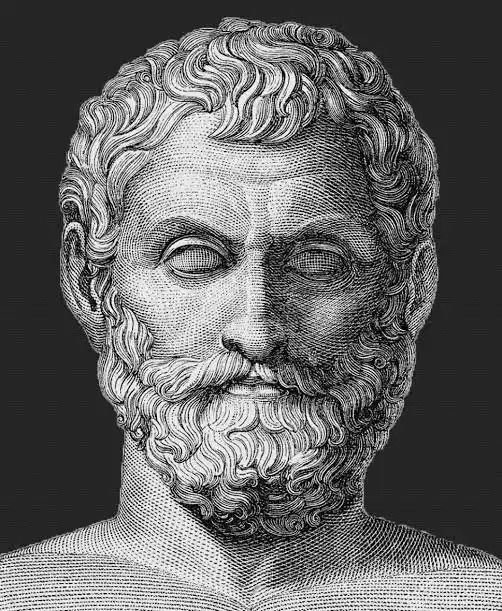
Thales of Miletus
Ancient Greek (Ionian)
624 BC – 546 BC
Ancient Greek philosopher, mathematician, and astronomer regarded as the father of Western philosophy. Founder of the Milesian School and one of the Seven Sages of Greece.
View Profilearrow_right_alt
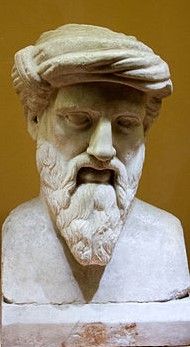
Pythagoras of Samos
Ancient Greek (Ionian)
570 BC – 495 BC
Ancient Greek philosopher, mathematician, and founder of the Pythagorean brotherhood. He made foundational contributions to mathematics, music theory, astronomy, and philosophy. His teachings on the numerical essence of reality profoundly influenced Plato, Aristotle, and the entire trajectory of Western rational thought.
View Profilearrow_right_alt
article
No articles yet
Articles for this era will appear here soon.