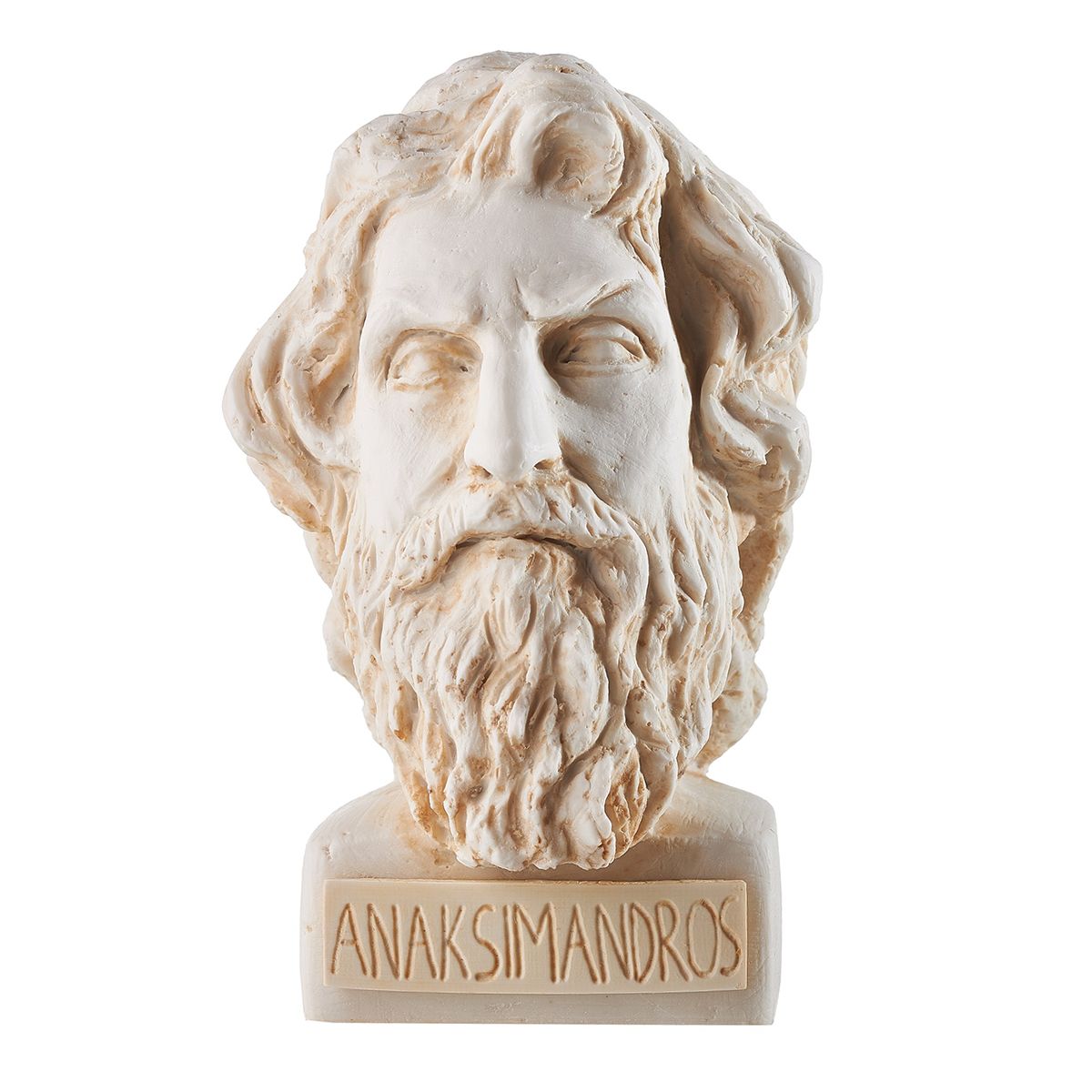
Natural Philosophy-Ancient Era
Anaximander (Ἀναξίμανδρος)
Born
610 BC
Died
546 BC
Birthplace
Miletus (Miletos), Ionia – Present-day Didim, Aydın Province, Turkey
Nationality
Ancient Greek (Ionian)
Active Years
c. 570 – c. 546 BCE
Pre-Socratic Greek philosopher from Miletus, widely regarded as the founder of cosmology. A student of Thales, Anaximander proposed the 'apeiron' (the Boundless) as the origin of all things, authored the first known prose treatise, drew the first world map, and became the first speculative astronomer to describe the mechanics of celestial bodies on a rational basis.
Known For
Apeiron (τὸ ἄπειρον) — The First Principle
First Rational Cosmological Model
First World Map (Γεωγραφικὸς Πίναξ)
First Known Prose Philosophical Treatise
Proto-Evolutionary View of Biology
Mechanical Model of Celestial Bodies
scienceMain Contributions
Anaximander stands as the architect of several of the earliest and boldest intellectual breakthroughs in Western thought. His contributions span cosmology, metaphysics, astronomy, geography, and biology.
1. The Concept of Apeiron (ἄπειρον)
Contrary to Thales, who proposed water as the archē (first principle), Anaximander attributed the origin of the universe not to any particular element but to the 'apeiron' — the Boundless, Indefinite, and Inexhaustible. This concept elevated Greek philosophy to an unprecedented level of conceptual abstraction and is considered one of the first metaphysical propositions in history.
2. Cosmological Model
He described the Earth as a cylindrical body (resembling a column drum) floating freely in space, supported by nothing. He argued that because the Earth is equidistant from all celestial bodies, it has no disposition to move in any direction. This constitutes the first rational cosmological model, positing that the universe operates according to geometric order.
3. First World Map
He is credited with drawing the first known world map (γεωγραφικὸς πίναξ). This circular map placed Delphi at its centre, with the northern half designated as Europe and the southern half as Asia.
4. Introduction of the Gnomon to Greece
He erected a gnomon (shadow-casting sundial rod) at Sparta, using it to determine solstices, equinoxes, and presumably the hours of the day.
5. First Known Prose Treatise
His work 'On Nature' (Peri Physeos) is regarded as the first known prose text on natural philosophy in the Western world.
6. Proto-Evolutionary Thought
He proposed that the first living creatures emerged in moisture enclosed in thorny barks, and that humans must have descended from fish-like creatures, since human infants require prolonged nurture and could not have survived in their present form from the beginning.
south_westInfluenced By
Thales of Miletus
Anaximander's teacher and the founder of the Milesian School. Thales' proposal of water as the archē provided the intellectual foundation from which Anaximander developed his concept of the apeiron. Thales inaugurated the tradition of seeking rational, non-mythological explanations for natural phenomena.
Hesiod
Hesiod's concept of 'Chaos' (the primordial void or abyss) in the Theogony may be regarded as a mythological precursor to Anaximander's apeiron. Hesiod's cosmogony expressed in mythic form the idea of cosmic order that Anaximander subsequently rationalised.
Babylonian Astronomers
Babylonian celestial observations, the use of the gnomon, and the cartographic tradition indirectly influenced Anaximander's work. The gnomon and the division of the day into twelve parts are of Babylonian origin.
north_eastInfluenced
Anaximenes of Miletus
Anaximander's direct pupil and the third representative of the Milesian School. Anaximenes adopted air rather than the apeiron as the archē, but continued his master's method of rational cosmology.
Pythagoras of Samos
Several ancient sources identify Pythagoras as a pupil of Anaximander. The idea that the universe operates according to a geometric-mathematical order may have been transmitted from Anaximander to Pythagoras.
Hecataeus of Miletus
Hecataeus took Anaximander's world map as his starting point and produced a more accurate version. This work, which pioneered the development of geography as a discipline, is the direct continuation of Anaximander's cartographic legacy.
Aristotle
Anaximander's ideas were extensively discussed and transmitted within the Aristotelian tradition, most notably in Theophrastus' history of philosophy. Aristotle analysed the concept of apeiron in detail in his Physics.
Plato
Some scholars have argued that the cosmological framework in Plato's Timaeus may have been influenced by Anaximander's concept of the apeiron.
Life and Character
Biographical information about Anaximander is extremely limited and relies largely on accounts by writers who lived centuries after him. According to Apollodorus, he was born around 610 BCE in Miletus and died around 546/545 BCE.
His father was Praxiades. Some ancient sources suggest a kinship with Thales (possibly his nephew). He became a pupil or close associate of Thales and subsequently assumed the position of second head of the Milesian School.
Anaximander travelled extensively and was chosen by the Milesians to lead an expedition to found a colony called Apollonia on the coast of the Black Sea. This selection attests not only to his intellectual standing but also to his active role in the civic and political sphere.
He erected a gnomon (sundial rod) at Sparta and used it to determine solstices, equinoxes, and presumably the hours of the day. Ancient sources report that he displayed solemn manners and wore pompous garments.
According to Cicero (De Divinatione), Anaximander warned the inhabitants of Lacedaemon (Sparta) of an impending earthquake, urging them to leave the city and spend the night in the open with their weapons. The earthquake duly occurred and the city sustained damage. This anecdote reflects Anaximander's capacity for prediction based on natural observation.
lightbulbMajor Discoveries
The Apeiron: The Boundless First Principle
Anaximander's most fundamental and original philosophical contribution is his explanation of the origin of the universe through the concept of the 'apeiron' (ἄπειρον — Boundless, Indefinite, Infinite).
Thales had proposed water as the archē (ἀρχή — beginning, first principle). Anaximander took a critical step further by developing the following argument: water can only be moist, never dry. Any particular element cannot generate its opposite and is therefore unable to account for all the opposites found in nature. Consequently, the archē cannot be an element possessing specific qualities; it must be a boundless source that cannot be reduced to any particular quality and potentially contains all opposites.
The apeiron is eternal — unborn and imperishable. All opposites (hot–cold, moist–dry) emerge from it through separation and ultimately return to it. This cyclical process occurs by necessity and 'according to the ordinance of time'.
This concept is revolutionary in several respects. First, it places an abstract principle — one not directly perceptible to the senses — at the centre of philosophical argument. Second, it proposes that the cosmic order is governed not by divine will but by an inherent necessity (anankē) and justice (dikē). Third, it advances the idea that innumerable worlds are born from and destroyed back into the apeiron — a kind of 'oscillating universe' model.",
Significance: The concept of the apeiron represents the first and most radical instance of the transition from concrete observation to abstract thought in Western philosophy. With this concept, Anaximander is recognised as the first metaphysician. The apeiron provided early intellectual groundwork for Plato's 'Ideas', Aristotle's distinction between potentiality and actuality, and modern cosmological debates about the infinite universe.
The Earth Floating Freely in Space and Geometric Cosmology
Anaximander was the first thinker to propose that the Earth floats freely in space, supported by nothing. Thales had assumed that the Earth floats on water — an explanation that left unanswered the question 'what supports the water?' (the problem of infinite regress).
Anaximander resolved this problem with a geometric argument: the Earth is at the centre of the universe and equidistant from all extremes. Since there is no reason (no asymmetry) for it to move in any particular direction, the Earth remains in place. This argument was transmitted by Aristotle (De Caelo, 295b11) and is regarded as an early form of Leibniz's Principle of Sufficient Reason.
Anaximander described the Earth as shaped like a column drum — a cylinder whose diameter is three times its height. Humans live on one of the flat surfaces. This shape is a logically consistent choice for a body floating freely in space, given the assumption that the Earth is flat and circular (as suggested by the horizon).
For the celestial bodies, he proposed a model of concentric rings filled with fire. These rings are enveloped in mist, and fire shines through apertures on their inner surfaces. The Sun ring is at 27, the Moon ring at 18, and the star ring at 9 Earth-radii. These ratios (9×1, 9×2, 9×3) reflect a systematic mathematical order.
Significance: The idea that the Earth floats freely in space was confirmed more than 2,500 years later in the Space Age. This concept constitutes a revolutionary step that freed cosmological thought from mythological supports (Atlas, turtles, etc.) and established it within a geometric-mathematical framework.
First World Map and Geography
Anaximander is credited with drawing the first known world map (γεωγραφικὸς πίναξ). Herodotus saw and described such early maps.
The map was circular in form and represented the upper surface of his cylindrical Earth model. The river Ocean encircled the map. At the centre stood Delphi, regarded as the navel (omphalos) of the world. A line divided the map into two halves: the northern half was designated 'Europe' and the southern/eastern half 'Asia'.
This map served multiple practical purposes: facilitating trade between Miletus and its colonies across the Mediterranean and the Black Sea, visualising the political unity of the Ionian city-states, and providing a philosophical tool for comprehending the world as a whole. The map was subsequently corrected and improved by Hecataeus of Miletus.
Significance: The endeavour to create a universal, systematic visual representation of the known world is the achievement that earns Anaximander recognition as the first geographer. This work constitutes the starting point of the cartographic tradition that extends from Hecataeus to Eratosthenes and Ptolemy.
Proto-Evolutionary View of Biology
Anaximander's biological views occupy a highly original position within antiquity. According to the accounts transmitted by Aëtius and other doxographers:
- The first living creatures emerged in the moist environment that the Sun had not yet dried, enclosed in thorny barks (structures resembling shells or husks).
- As these creatures matured, they moved to drier areas and, when their barks broke off, adapted to a different mode of life.
- Humans must have descended from creatures of a different kind — specifically from fish-like beings. The reason is that the human infant, compared to other animals, requires prolonged nurture and could not have survived on its own in its present form.
These views are remarkable for implying that living organisms undergo transformation in response to environmental conditions and that species are not fixed. Although they cannot be directly equated with modern evolutionary theory, they are pioneering in proposing that the origin of life can be explained through natural processes and that organisms may transform into one another.
Significance: Anaximander's biological views represent one of the first systematic attempts to attribute the origin of life to natural processes rather than supernatural creation. The idea that humans may have descended from other creatures is a bold foresight, predating Darwin by approximately 2,400 years.
functionNotable Equations
Diameter : Height = 3 : 1
Dimensional Ratio of the Earth
Anaximander likened the Earth to a column drum and proposed that its diameter is three times its height. This ratio constitutes the fundamental geometric parameter of his cosmological model.
Stars : Moon : Sun = 9 : 18 : 27 (in Earth-radii)
Distance Ratios of Celestial Bodies from the Earth
He expressed the distances of celestial bodies proportionally to the dimensions of the Earth. The star ring is positioned at 9, the Moon ring at 18, and the Sun ring at 27 Earth-radii. These ratios (9, 18, 27 = 9×1, 9×2, 9×3) reflect a systematic mathematical order.
The Earth is at the centre because it is equidistant from all extremes; therefore, it has no reason to move in any direction.
Principle of Geometric Equilibrium (Sufficient Reason)
This argument is regarded as an early formulation of Leibniz's Principle of Sufficient Reason (Principium Rationis Sufficientis). Anaximander explained the position of the Earth not through mythology but through the principle of geometric symmetry.
timelineTimeline
c. 610 BCE
Birth
Born in Miletus (Ionia, Western Anatolia) as the son of Praxiades.
c. 580–570 BCE
Studies with Thales
Receives instruction as a pupil or associate of Thales, the founder of the Milesian School, in natural philosophy, astronomy, and geometry.
c. 570 BCE
Headship of the Milesian School
Succeeds Thales as the second head (scholarch) of the Milesian School. Teaches Anaximenes and, arguably, Pythagoras.
c. 560–550 BCE
Composition of 'On Nature'
Writes his treatise 'On Nature' (Peri Physeos / Περὶ Φύσεως). This work is regarded as the first known prose text on natural philosophy in the Western world.
c. 560–550 BCE
Drawing of the First World Map
Draws a circular map of the known world. This map would later be improved by Hecataeus of Miletus.
c. 560–550 BCE
Erection of the Gnomon at Sparta
Erects a gnomon (sundial rod) at Sparta and uses it to determine solstices, equinoxes, and presumably the hours of the day.
c. mid-6th century BCE
Foundation of the Apollonia Colony
Chosen by the Milesians to lead (as oikistes) an expedition to found a colony called Apollonia on the coast of the Black Sea.
c. 546 BCE
Death
Dies in Miletus. His treatise was presumably preserved in various libraries for centuries but was eventually lost. Only a single sentence-long fragment (transmitted via Simplicius) has survived to the present day.
psychologyHistorical and Intellectual Context
Anaximander lived in Miletus, the foremost commercial and cultural centre of Ionia in the 6th century BCE. This period marks a critical turning point in Greek thought — the transition from mythological explanation to rational inquiry — sometimes referred to by scholars as the 'Greek Miracle'.
Thanks to its extensive trade network across the Mediterranean and the Black Sea, Miletus was in direct contact with the intellectual heritage of Egypt, Babylon, and Phoenicia. Babylonian astronomical observations and Egyptian expertise in geometry and engineering nourished this intellectual milieu.
The tradition inaugurated by Thales — attributing natural phenomena to natural laws rather than to the whims of the gods — was carried considerably further by Anaximander. Thales had proposed water as the archē but never committed his ideas to writing. Anaximander both systematised this tradition into a prose treatise and elevated the concept of archē from a concrete element (water) to an abstract principle (apeiron), thereby radically expanding the capacity for philosophical abstraction.
During this same period, major temple constructions were under way in Ionia (the Temple of Apollo at Miletus, the Temple of Artemis at Ephesus). Scholars such as Robert Hahn have argued that Anaximander's geometric cosmological model may have been inspired by the ground plans and geometric diagrams employed by Greek and Egyptian architects.
Anaximander's work laid the groundwork for the third representative of the Milesian School, Anaximenes, and for the subsequent Pre-Socratic philosophers (Heraclitus, Parmenides, Empedocles), thereby contributing to the establishment of the tradition of rational inquiry into nature within Western thought.