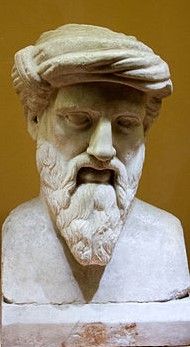
Natural Philosophy-Ancient Era
Pythagoras of Samos
Born
570 BC
Died
495 BC
Birthplace
Samos, Ionia (present-day Pythagoreio, Samos, Greece)
Nationality
Ancient Greek (Ionian)
Active Years
c. 535 – c. 495 BCE
Ancient Greek philosopher, mathematician, and founder of the Pythagorean brotherhood. He made foundational contributions to mathematics, music theory, astronomy, and philosophy. His teachings on the numerical essence of reality profoundly influenced Plato, Aristotle, and the entire trajectory of Western rational thought.
Known For
Pythagorean Theorem
Theory of Musical Harmony
Number Philosophy (Arithmology)
Doctrine of Metempsychosis
Founding of the Pythagorean Brotherhood
Tetractys
scienceMain Contributions
Mathematics Pythagoras and his school made fundamental contributions to the theory of numbers, geometry, and the concept of mathematical proof. The Pythagorean theorem (a² + b² = c²), though known empirically in earlier civilizations, received its first deductive proof in the Greek tradition through the Pythagorean school. The Pythagoreans studied figurate numbers (triangular, square, pentagonal), perfect numbers, and the properties of odd and even integers. The discovery of irrational numbers—specifically the incommensurability of the diagonal of a square with its side—emerged within the school and posed a fundamental challenge to their doctrine that all things are numbers.
Music Theory Pythagoras discovered the mathematical basis of musical harmony by demonstrating that consonant musical intervals correspond to simple numerical ratios. Using a monochord, he showed that an octave corresponds to a 2:1 ratio, a perfect fifth to 3:2, and a perfect fourth to 4:3. This insight formed the foundation of the Pythagorean tuning system and led to the broader philosophical claim that the cosmos itself is organized according to harmonic proportions (the 'Harmony of the Spheres').
Philosophy and Cosmology Pythagoras pioneered the idea that the universe is fundamentally mathematical in structure. His doctrine that 'all is number' represents one of the earliest formulations of mathematical realism. The Pythagorean cosmology, later developed by Philolaus, proposed a non-geocentric model of the universe with a central fire, anticipating aspects of heliocentric thought.
Ethics and Way of Life Pythagoras established a comprehensive ethical framework centered on the purification and elevation of the soul through intellectual discipline, ascetic practice, and communal living. The doctrine of metempsychosis (transmigration of souls) provided a moral cosmology linking human conduct to the soul's ultimate fate.
south_westInfluenced By
Thales of Miletus
The first Greek philosopher and proto-scientist who advised Pythagoras to travel to Egypt. Thales introduced him to mathematical and astronomical reasoning.
Anaximander (Ἀναξίμανδρος)
Pupil of Thales who influenced Pythagoras with his cosmological theories and the concept of the apeiron (the boundless).
Pherecydes of Syros
Considered one of Pythagoras's primary teachers. Pherecydes is credited with influencing Pythagoras's belief in the immortality and transmigration of the soul.
Egyptian Priests (Thebes)
During his extensive travels in Egypt (possibly spanning over two decades), Pythagoras reportedly studied geometry, astronomy, and religious rites with the Egyptian priesthood.
Babylonian Magi
Pythagoras is said to have studied arithmetic, music, and astronomical observation from Babylonian scholars, absorbing their advanced mathematical knowledge.
north_eastInfluenced
Philolaus of Croton
Early Pythagorean who first published the doctrines of the school. He developed the first non-geocentric model of the cosmos, with a central fire around which Earth and other celestial bodies revolve.
Archytas of Tarentum
Pythagorean mathematician, statesman, and friend of Plato, who made major contributions to geometry, harmonics, and mechanics.
Plato
Pythagorean numerical philosophy profoundly shaped Plato's theory of Forms, his cosmology in the Timaeus, and his belief in the mathematical structure of reality.
Aristotle
Although critical of Pythagorean metaphysics, Aristotle extensively discussed and engaged with Pythagorean doctrines, providing major source material about their teachings.
Euclid
Euclid's Elements systematized and provided rigorous proofs for many results first discovered or studied by Pythagoreans, including the theorem bearing Pythagoras's name.
Hippasus of Metapontum
Pythagorean credited with the discovery of irrational numbers (incommensurable magnitudes), which created a crisis in Pythagorean number philosophy.
Nicomachus of Gerasa
Neopythagorean mathematician whose Introduction to Arithmetic preserved and transmitted Pythagorean number theory to the medieval world.
Early Life and Education
Pythagoras was born around 570 BCE on the island of Samos, off the coast of Asia Minor (modern Turkey), to Mnesarchus, a prosperous gem-engraver or merchant, and Pythais. Ancient sources agree that he received an excellent education, learning to play the lyre, studying poetry, and reciting Homer from an early age.
Three philosophers exercised formative influence on the young Pythagoras. Pherecydes of Syros, widely regarded as his most important teacher, introduced him to ideas about the immortality of the soul. Thales of Miletus, whom Pythagoras reportedly visited between the ages of 18 and 20, sparked his interest in mathematics and astronomy and advised him to travel to Egypt for further study. Anaximander, Thales's pupil, exposed him to cosmological speculation.
According to later tradition, Pythagoras undertook extensive travels lasting perhaps two decades, studying with Egyptian priests in the Nile Delta, Babylonian scholars (where he may have encountered advanced arithmetic and astronomical tables), and possibly Phoenician and Persian sages. While the exact duration and scope of these travels remain debated among scholars, the breadth of Pythagoras's intellectual synthesis suggests genuine exposure to multiple knowledge traditions.
The Pythagorean School at Croton
Around 530 BCE, Pythagoras emigrated to Croton (modern Crotone), a Greek colony in southern Italy. His departure from Samos is commonly attributed to disagreement with the tyranny of Polycrates, though some scholars suggest the political climate of Persian expansion into Ionia was the primary motivating factor.
At Croton, Pythagoras founded a philosophical school that functioned simultaneously as a religious brotherhood, an intellectual academy, and a political association. The community followed strict rules of conduct, including dietary restrictions (abstinence from meat and beans), ritual practices, periods of silence, and communal ownership of property.
Members were organized into two classes: the mathematikoi (learners), who constituted the inner circle and engaged in advanced study of arithmetic, geometry, music theory, and astronomy; and the akousmatikoi (listeners), who adhered to Pythagorean ethical precepts and oral teachings without necessarily pursuing theoretical studies. New initiates reportedly underwent a five-year period of silence before being admitted to the inner circle.
The school's intellectual program was structured around four disciplines that later became known as the quadrivium: arithmetic (number in itself), geometry (number in space), music/harmonics (number in time), and astronomy (number in space and time). This fourfold division of mathematical education would dominate Western curricula for nearly two millennia.
Political Activity and Downfall
Pythagoras rapidly acquired significant political influence in Croton, serving as an adviser to the city's elite and delivering public speeches on virtue and civic duty. The Pythagorean community's political involvement, however, generated increasing resentment.
Around 509 BCE, a violent anti-Pythagorean revolt erupted in Croton, traditionally attributed to Cylon of Croton, a wealthy aristocrat who had been rejected for admission to the brotherhood. The revolt resulted in the burning of Pythagorean meeting houses and the persecution of members. Pythagoras fled to Metapontum, another Greek city in southern Italy, where he reportedly spent his final years.
He died around 495 BCE at Metapontum. The circumstances of his death are uncertain: some accounts describe him dying of grief over the destruction of his community, while others place him among the victims of anti-Pythagorean violence. Despite this political catastrophe, the Pythagorean movement survived and continued to develop, producing significant thinkers such as Philolaus and Archytas in the following century.
lightbulbMajor Discoveries
The Pythagorean Theorem and Geometric Proof
While the empirical relationship between the sides of a right triangle (a² + b² = c²) was known to Babylonian mathematicians over a millennium before Pythagoras, the Greek contribution—attributed to the Pythagorean school—was the concept of deductive proof. Rather than merely observing that the relationship held for specific cases, the Pythagoreans sought to demonstrate its universal necessity through logical reasoning.
The theorem established a paradigm for mathematical knowledge as certain, demonstrative, and universal—a conception that would shape Western epistemology through Plato, Euclid, Descartes, and beyond. The Pythagorean approach to mathematics as a deductive science, proceeding from axioms through logical proof, became the model for all subsequent Western mathematics.
Discovery of Irrational Numbers
One of the most consequential discoveries to emerge from the Pythagorean school was the existence of incommensurable magnitudes—what we now call irrational numbers. Attributed most commonly to Hippasus of Metapontum, this discovery arose from the attempt to measure the diagonal of a unit square, which yields √2.
The proof that √2 cannot be expressed as a ratio of two integers struck at the heart of the Pythagorean doctrine that 'all is number,' since 'number' for Pythagoreans meant rational number. This mathematical crisis forced a profound revision of Greek mathematics, ultimately leading to the geometrical algebra of Euclid's Elements, where magnitudes rather than numbers became the primary objects of mathematical reasoning.
functionNotable Equations
Pythagorean Theorem
In any right-angled triangle, the square of the length of the hypotenuse (c) is equal to the sum of the squares of the lengths of the other two sides (a, b). This is arguably the most fundamental theorem in Euclidean geometry.
Musical Ratio – Octave
The frequency ratio defining an octave interval. Pythagoras discovered that when two strings, one twice the length of the other, are plucked, they produce notes an octave apart.
Musical Ratio – Perfect Fifth
The frequency ratio of a perfect fifth. This ratio was central to the Pythagorean tuning system, which built all musical intervals from successive perfect fifths.
Musical Ratio – Perfect Fourth
The ratio producing a perfect fourth interval in the Pythagorean scale.
Tetractys Summation
The sacred sum of the tetractys, which Pythagoreans regarded as the most perfect number, embodying the structure of the cosmos: 1 = point, 2 = line, 3 = surface, 4 = solid.
α + β + γ = 180°
Sum of Interior Angles of a Triangle
The theorem that the sum of the interior angles of any triangle equals two right angles (180°), a proof attributed to the Pythagorean school.
timelineTimeline
c. 570 BCE
Birth on Samos
Pythagoras is born on the island of Samos, Ionia, to Mnesarchus and Pythais.
c. 551 BCE
Studies with Thales
Pythagoras visits the elderly Thales of Miletus, who inspires his interest in mathematics and advises him to travel to Egypt.
c. 550–530 BCE
Travels in Egypt and Babylon
Extended period of study abroad, absorbing Egyptian geometry, Babylonian arithmetic, and various religious and mystical traditions.
c. 530 BCE
Foundation of the School at Croton
Pythagoras emigrates to Croton in Magna Graecia and establishes the Pythagorean brotherhood.
c. 530–520 BCE
Major Mathematical and Musical Discoveries
Period of the school's greatest intellectual productivity, including work on the theorem, musical ratios, and number theory.
c. 509 BCE
Anti-Pythagorean Revolt
Cylon of Croton leads a violent uprising against the Pythagorean community. Meeting houses are burned and members are persecuted.
c. 509–495 BCE
Exile in Metapontum
Pythagoras flees to Metapontum, where he spends his final years.
c. 495 BCE
Death at Metapontum
Pythagoras dies at Metapontum. The exact circumstances of his death remain historically uncertain.
psychologyThe Intellectual Revolution of the Pre-Socratic Era
Pythagoras lived during one of the most transformative periods in human intellectual history—the 6th century BCE, when Greek thinkers began seeking rational explanations for natural phenomena, moving beyond mythological accounts. The Ionian philosophers (Thales, Anaximander, Anaximenes) had already initiated this revolution by proposing natural substances as the fundamental principle (arché) of all things.
Pythagoras's radical innovation was to propose that the fundamental principle was not a material substance but an abstract, mathematical entity: number. This shift from material to formal explanation marks a watershed in the history of Western thought, anticipating by over two millennia the mathematical physics of Galileo, Kepler, and Newton.
The political context was equally significant. The Greek world of the 6th century BCE was characterized by the rise and fall of tyrannies, colonization of southern Italy and Sicily (Magna Graecia), and increasing contact with the advanced civilizations of Egypt and Mesopotamia. Pythagoras's migration from Samos to Croton reflected both the political instability of Ionian Greece under Persian expansion and the vibrant intellectual climate of the western Greek colonies.