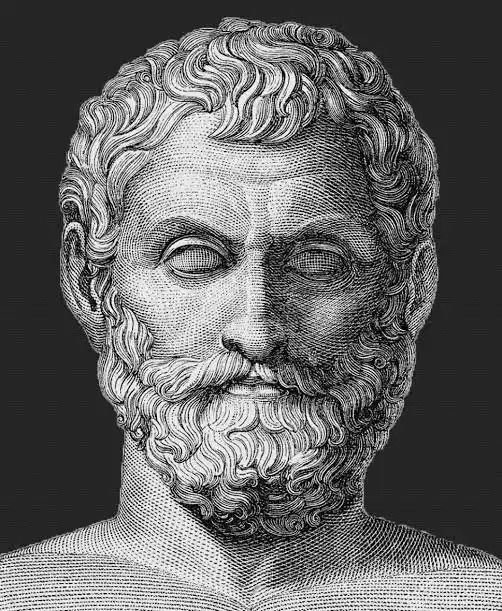
Natural Philosophy-Ancient Era
Thales of Miletus
Born
624 BC
Died
546 BC
Birthplace
Miletus (Miletos), Ionia – Present-day Didim, Aydın Province, Turkey
Nationality
Ancient Greek (Ionian)
Active Years
c. 600 BC – c. 546 BC
Ancient Greek philosopher, mathematician, and astronomer regarded as the father of Western philosophy. Founder of the Milesian School and one of the Seven Sages of Greece.
Known For
Father of Western Philosophy
Arche Concept — Water as the Source of All Things
Thales' Theorem
Intercept Theorem (Basic Proportionality Theorem)
Solar Eclipse Prediction (585 BC)
Founder of the Milesian (Ionian) School
One of the Seven Sages of Ancient Greece
Measurement of the Pyramids' Height
Observations on Electrostatics and Magnetism
scienceMain Contributions
Philosophy
- Arche Concept: Proposed that all things in the universe originate from a single fundamental substance — water (hydor). This represents the first systematic search for an "arche" (first principle) in the history of philosophy.
- Materialist Monism: Put forward the idea that all existing things can be reduced to a single substance.
- Hylozoism: Declared that "all things are full of gods," suggesting that even seemingly inanimate objects possess a kind of soul (psyche).
- Transition from Myth to Reason: Replaced mythological explanations of natural phenomena with methods based on reason and observation, without invoking the Olympian gods.
Mathematics and Geometry
- Thales' Theorem (the inscribed angle in a semicircle is always 90°)
- Intercept Theorem (proportional segments created by parallel lines cutting two transversals)
- Proved that a circle's diameter bisects the circle into two equal parts
- Demonstrated the equality of base angles in an isosceles triangle
- Proved the equality of vertical (opposite) angles
- Calculated the height of the Egyptian pyramids using shadow ratios
- Measured the distance of ships from shore using geometric methods
Astronomy
- Predicted the solar eclipse of May 28, 585 BC
- Determined the dates of the solstices and equinoxes
- Calculated the length of the year as 365 days
- Recommended using Ursa Minor for maritime navigation
- Attempted to calculate the sizes of the Sun and Moon
Engineering
- Diverted the course of the Halys (Kızılırmak) River to allow the Lydian army to cross
Economics
- Executed what is considered the first known futures or options contract in history through olive press speculation
south_westInfluenced By
Egyptian Priests (Thebes)
Received training in geometry and astronomy
Babylonian Astronomers
Acquired eclipse cycle and solstice knowledge
Homer
May have inspired his water arche
Phoenician Seafarers
Maritime and celestial navigation traditions
north_eastInfluenced
Anaximander (Ἀναξίμανδρος)
Direct student; developed the arche as "apeiron"
Anaximenes of Miletus
Third Milesian philosopher; identified air as arche
Pythagoras of Samos
Reportedly advised him to travel to Egypt
Heraclitus
Influenced through the monist tradition
Xenophanes
Expressed admiration for Thales
Democritus
Was acquainted with Thales' ideas
Plato
Counted him among the Seven Sages
Aristotle
Regarded him as the first philosopher
Eudemus
Systematically recorded his discoveries
Proclus
Documented his geometric theorems
Overview
Thales was a pre-Socratic Ancient Greek philosopher, mathematician, and astronomer regarded as the founder of Western philosophy and scientific thought. He established the Milesian (Ionian) School — the first known school of philosophy — and was counted among the Seven Sages of Ancient Greece.
He proposed that the fundamental substance of the universe is water (hydor), pioneering natural philosophy over mythological explanations. By seeking to explain natural phenomena through reason and observation rather than divine intervention, he became the first person to engage in what we now call science and philosophy. Aristotle considered him the first philosopher and his own intellectual predecessor.
His contributions to geometry and astronomy remain foundational; Thales' Theorem is still taught in classrooms worldwide. His prediction of the solar eclipse of 585 BC stands as one of the most remarkable scientific achievements of the ancient world.
Early Life and Family
Thales was born around 624–625 BC in Miletus, one of the most important trading cities in the Ionia region of western Anatolia (present-day Didim district, Aydın Province, Turkey). His father Examyas and mother Cleobulina belonged to a noble family known as the Thelidae.
According to ancient sources such as Herodotus and Diogenes Laërtius, this family was of Phoenician descent, tracing their lineage to Cadmus and Agenor. However, some modern historians argue that Thales was entirely Greek in origin and that the Phoenician attribution was a later addition. His father bore a Carian name while his mother had a Greek name, suggesting the possibility of mixed ancestry.
Diogenes Laërtius also provides a competing account, noting that "most writers represent him as a genuine Milesian and of a distinguished family." Miletus itself was a vibrant port city at the crossroads of Eastern and Western cultures, where ideas from different civilizations converged — an environment ideally suited to nurturing the young Thales' intellectual development.
Travels to Egypt and Babylon
Several ancient sources indicate that Thales visited Egypt at some point in his life and learned geometry there. The existence of Naucratis, a permanent Milesian trading colony in Egypt, makes this journey highly plausible. According to tradition, Thales established close relationships with the priests of Thebes, receiving instruction in astronomy and geometry — and, by some accounts, instructing them in geometry as well.
During his Egyptian sojourn, Thales is said to have measured the height of the pyramids by waiting until the moment when his own shadow equaled his body height and then measuring the pyramid's shadow. This method represents an early and elegant practical application of the principle of similar triangles.
A visit to Babylon is also considered probable. Some historians suggest that Thales acquired a significant portion of his astronomical knowledge from Babylonian sky-watchers. The influence of the sexagesimal system (base-60) on Greek thought is evaluated in this context. However, as the historian Roger L. Cooke notes, "this relation is controversial."
Political Activities and Engineering
Thales was not merely a thinker; he was also an active political counselor. He maintained close relations with Thrasybulus, the tyrant of Miletus. According to Diogenes Laërtius, Thales advised the Milesians not to enter a military alliance (symmachia) with the Lydians. Thanks to this counsel, when King Croesus was defeated by Cyrus the Great of Persia, Miletus was spared.
Thales further advocated for the Ionian city-states to form a federated union against Lydia and Persia. He proposed Teos as the seat of this federation, suggesting that the other cities could continue to enjoy their own laws as if they were independent states.
One of the most celebrated episodes illustrating Thales' practical engineering ability comes from Herodotus. When King Croesus' army reached the Halys (Kızılırmak) River and could not cross, Thales ordered a canal to be dug behind the army's camp. Once the final dam was breached, the water flowed into the new channel, allowing the army to cross the old riverbed without even getting their feet wet.
Personal Life and Death
Conflicting accounts exist regarding Thales' marriage. Some sources state that he married and had a son named Cybisthus (or Cybisthon), or that he adopted a nephew of the same name. Others report that he never married at all. According to Plutarch, when Solon asked Thales why he remained unmarried, Thales told his mother in his youth that it was too early and in his old age that it was too late.
One of the most famous anecdotes about Thales appears in Plato's Theaetetus: while gazing at the stars, Thales failed to notice a well in front of him and fell in, prompting a witty Thracian servant girl to mock him for being so eager to know what was happening in the heavens that he could not see what was right at his feet. This story became the archetypal tale of the absent-minded philosopher — absorbed in abstract thought while neglecting practical realities.
According to Diogenes Laërtius, Thales died during the 58th Olympiad (c. 548–545 BC) while watching the Olympic Games, overcome by heat exhaustion. He was approximately 78 years old at the time of his death.
lightbulbMajor Discoveries
Prediction of the Solar Eclipse (585 BC)
Thales' greatest achievement in astronomy was predicting the solar eclipse of May 28, 585 BC. This event occurred during the battle between the Lydians and the Medes. When day suddenly turned to night, both sides halted the fighting and began peace negotiations. Herodotus, Eudemus, Cicero, Pliny, and several other ancient writers confirmed the success of this prediction. Modern astronomy verifies that the eclipse did indeed occur and was total. Thales most likely based this prediction on Babylonian astronomical cycle data.
Significance: This prediction was one of the earliest demonstrations that celestial events follow predictable, regular cycles. It strengthened the revolutionary idea that natural phenomena are governed by foreseeable laws rather than divine caprice.
Arche: Water as the Source of All Things
Thales proposed that all matter in the universe is composed of a single fundamental substance — water. According to Aristotle (Metaphysics, 983b), Thales may have reached this conclusion because all living things depend on water for survival, and because the seeds and nourishment of all organisms are moist in nature. Observing that earth residue remains after water evaporates may have further influenced his reasoning. Aëtius added that Thales believed even the fire of the sun and stars and the cosmos itself is nourished by the evaporation of waters.
Significance: This proposition represents the first systematic search for an 'arche' (first principle) in the history of philosophy. Its true importance lies not in the answer given but in the question asked: 'What is truly real?' The pursuit of a natural explanation instead of mythological narratives is regarded as the birth of scientific thought.
Thales' Theorem
Thales proved that any angle inscribed in a semicircle — that is, any angle subtended by the diameter of a circle from a point on the circumference — is always a right angle (90°). This theorem was attributed to Thales by Proclus in his commentary on the first book of Euclid's Elements, citing Eudemus as his source.
Significance: This is the earliest known theorem to employ deductive proof in geometry. This approach — establishing truths through logical reasoning from axioms — forms the foundational methodology of modern mathematics and science.
Observations on Electrostatics and Magnetism
Thales observed that amber (elektron in Greek), when rubbed against cat fur or hemp, attracts lightweight particles such as ash and dust. He also studied the property of lodestone (magnetic iron ore) to attract iron. From these observations, he concluded that even seemingly inanimate objects possess a kind of soul or vital force, declaring that 'all things are full of gods.'
Significance: These observations are the earliest recorded instances of electrostatic charge and magnetism. Thales had unknowingly observed the electron and magnetic force — concepts whose formal discovery would not occur for over two millennia. The Greek word for amber, 'elektron,' later gave its name to electricity itself.
functionNotable Equations
If AB is a diameter of a circle and C is any point on the circle, then ∠ACB = 90°
Thales' Theorem (Semicircle–Diameter Relation)
The inscribed angle subtended by a semicircle is always a right angle. This theorem also appears in Euclid's Elements and is one of the foundational results of modern geometry.
If d₁ ∥ d₂ ∥ d₃ cut two transversals, then
Intercept Theorem (Thales' Proportionality Principle)
When parallel lines intersect two transversals, the segments formed are proportional. This forms the basis of similar triangles and is applied in cartography, engineering, and numerous other fields.
Pyramid Height Calculation Method
Using the principle of similar triangles, Thales demonstrated that at the moment when the sun's angle makes a person's shadow equal to their height, the pyramid's shadow length equals the pyramid's height.
timelineTimeline
624 BC
Birth
Thales was born in the city of Miletus (Miletos), Ionia, as the son of Examyas and Cleobulina.
600 BC
Journey to Egypt
Thales traveled to Egypt, where he studied geometry and astronomy with the priests of Thebes. He measured the height of the pyramids using the shadow method.
595 BC
Founding of the Milesian School
Upon returning to Miletus, Thales established the Milesian (Ionian) School — the first known school of philosophy in history.
585 BC
Solar Eclipse Prediction
Predicted the solar eclipse of May 28, 585 BC, which occurred during the Battle of the Halys between the Lydians and the Medes. The sudden darkness caused both armies to cease fighting and negotiate peace.
585 BC
Halys River Engineering
Engineered the diversion of the Halys (Kızılırmak) River to enable King Croesus' Lydian army to cross.
580 BC
Olive Press Venture
Using his knowledge of astronomy to predict an abundant olive harvest, Thales reserved all olive presses in the region at low cost before the season. When demand surged, he rented them out at a premium — executing what is considered the first known options or futures contract in history.
546 BC
Death
Thales died while watching the 58th Olympic Games, reportedly from heat exhaustion. He was approximately 78 years old.
psychologyHistorical and Intellectual Context
Thales lived during the late 7th and first half of the 6th century BC in Ionia, one of the most dynamic regions of the Ancient Greek world. This was an era when commercial and cultural interaction between Eastern civilizations (Egypt, Babylon, Phoenicia) and the Greek world had reached its peak.
The Significance of Ionia
Miletus was a wealthy port city with 80–81 trade colonies. Situated at the crossroads of Eastern and Western cultures, the city offered a cosmopolitan environment where ideas from different civilizations converged. This setting provided ideal conditions for nurturing Thales' scientific and philosophical curiosity.
The Transition from Mythos to Logos
Before Thales, natural phenomena were explained through mythological narratives: earthquakes were Poseidon's wrath, lightning bolts were Zeus' weapon. Thales broke this tradition by becoming the first person to attempt to explain nature through reason and observation. This paradigm shift is considered one of the most significant intellectual turning points in human history.
Egyptian and Babylonian Influence
It is believed that Thales acquired a significant portion of his geometric knowledge from Egypt and his astronomical knowledge from Babylon. However, Thales did not merely adopt this knowledge as practical applications — he sought to generalize and prove them at a theoretical level, thus taking the first step toward the scientific method.
Contemporaries
Thales was a contemporary of Babylonian King Nebuchadnezzar II (r. 605–562 BC), Lydian King Croesus (r. 560–546 BC), Persian King Cyrus the Great (r. 559–530 BC), and the Athenian statesman Solon (c. 638–558 BC).